
Estimating and AI: Three Key Opportunities for Construction Entrepreneurs
Estimating plays a central role in the construction industry: it drives business growth and ensures its sustainability. But today, with teams working at full capacity and a constantly increasing volume of requests, a large part of estimators' time is taken up with repetitive tasks that do not add value.
It is precisely in this space—between what takes time and what truly requires an expert eye—that AI finds its full usefulness. It fits in where teams get bogged down in repetitive tasks, on tasks that slow down progress and ultimately reduce productivity.
At Explorai, after working with numerous estimators and construction contractors, we see the same reality: teams know what to do, but lack the time to do it effectively. It is in this gap that three levers naturally come into play to improve estimation without disrupting practices: automating surveys, strengthening documentary rigor, and supporting technical decisions.
1 - Automating repetitive estimation tasks with AI
AI to accelerate quantity extraction
Estimators see it every day: opening, sorting, and analyzing plans always takes a lot of time, regardless of the size of the project. It is an unavoidable step that comes up with every bid and represents a constant and inevitable burden for them.
As mentioned by Benoît Carle, Director of Business Development: " AI now makes it possible to automatically recognize the vast majority of elements present on construction plans. In many cases, it can extract up to 80 or 90% of the components needed for estimation. This does not replace the estimator, but it does reduce the workload associated with data collection and transcription. The professional role is shifting toward validation, adjustment, and critical analysis."
Addenda are another point of friction. Comparing versions of plans, identifying changes, and measuring their effects requires a great deal of rigor. AI can automatically compare documents, identify differences—clouds, announced changes, adjustments—and provide an initial idea of the impact on quantities. The estimator is thus presented with a pre-prepared file, which limits oversights and allows them to quickly and confidently validate what has actually changed.

2. AI that enhances documentary rigor
Preparing the packing slip is one of the steps where errors are most costly: omissions, misreading, incorrect quantities transcribed, etc. What's more, the time spent on estimation is never billable, which increases the pressure on teams.
Winning a bid is not always cause for celebration. Often, a winning price simply means that the bid submitted was lower than those of competitors. And when a price is too low, one question always arises: what did we miss?
Did we make a mistake?
This uncertainty often forces the estimator to revisit everything: plans, estimates, specific sections, quantities. These repeated revisions increase fatigue and the risk of errors.
This is where AI provides concrete support. By analyzing the entire tender file, it can generate a structured and standardized checklist. It identifies discrepancies, flags areas that need clarification, and suggests a uniform organization. This rigor reduces human error and lowers the risk of having to recheck a supposedly completed project.
By improving document quality from the outset, AI helps limit doubts after the fact and focus efforts on what matters: optimizing strategy and improving margins.
3 - Easy access to key information in plans and specifications
Estimates are often based on extensive research, technical requirements, standards, equipment, and complex sections of the quote. Each estimator has their own working method, which complicates continuity when a file has to be taken over by a colleague.
AI can find a note, clarify a requirement, or summarize a complex section in seconds. It presents information in a consistent and organized manner, reducing discrepancies between estimators and allowing you to quickly pick up where you left off without having to decode everything.

But its value doesn't stop there. By centralizing data from a single project, AI creates a continuity that traditional methods cannot provide. Estimators no longer have to navigate through dozens of documents or piece together the logic used by a colleague. Important information emerges more quickly, and a comprehensive understanding of a project becomes more accessible.
This consistency improves the fluidity of teamwork: more time is spent analyzing than searching. AI speeds up decision-making and reduces unnecessary back-and-forth between documents, which is becoming increasingly essential as projects follow one another and demands increase.
How AI is redefining estimation without replacing the profession
AI does not replace estimators. It has neither the objective nor the capacity to perform the entire estimation process, and it does not claim to understand the subtleties of a project as someone with years of experience can. The estimator's judgment, experience, and intuition remain at the heart of every important decision.
What AI really changes is how the estimator allocates their efforts. It takes on the most tedious and repetitive parts of the process—those that are time-consuming without requiring real judgment—and transforms them into faster, more structured steps.
This allows the estimator to stay focused on what really makes a difference in a bid. Understanding the project, assessing risks, comparing scenarios, validating technical choices, investing energy where their expertise is valuable.
And the effect is quickly apparent: every hour freed up improves the quality of work and boosts confidence in the submission. AI does not transform the profession, but it does adjust its pace so that teams can move forward more efficiently, with greater clarity and control.
An inevitable step for companies in the construction industry
Cost pressures, labor shortages, and increasingly complex projects are creating an environment where companies must do more with less. And in this context, estimating is often the first to feel the pressure because it is a highly volatile and crucial part of moving projects forward.
Organizations that adopt AI early on quickly reap real benefits: improved operational capacity, greater rigor, and increased flexibility to absorb fluctuations and peak periods. AI does not replace anything essential, but it gives teams breathing room and improves their productivity.
As Hugues Mailhot, Partner and Vice President of Explor.ai, points out: "The question is no longer whether AI should be part of the estimation process, but when. The technology is finally mature and ready to be implemented. Companies that get ahead will develop a level of maturity that will be difficult for others to catch up with."
Estimates change, and tools must keep pace
AI now makes it possible to reduce the time spent on repetitive tasks, improve the quality of submissions, and support technical decisions. The role of the estimator remains central: they are the ones who ensure that prices are accurate. Companies that integrate these tools respond more quickly, with less stress and fewer oversights, which naturally protects their margins.
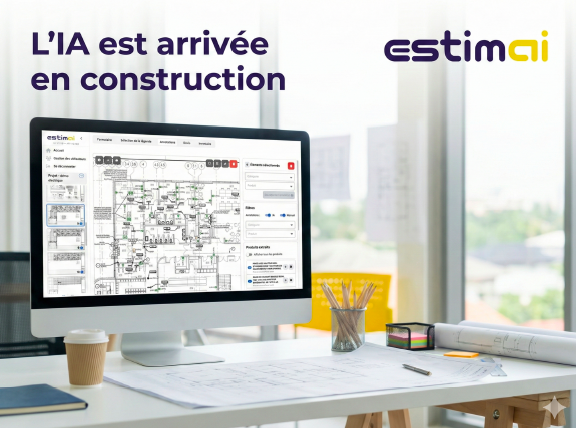
With Estim.ai, we help construction estimation teams speed up surveying, compare addenda, and structure the bill of quantities, while keeping human validation at the center. The platform integrates with your current methods and, above all, removes everyday irritants.
For more information, visit: www.estim.ai